In the chemical and plastics industries, not all goods are transported in the same way. Bags of raw materials, drums, large-volume containers and packaged chemicals require storage and transport solutions adapted to their specific characteristics. Although it often goes unnoticed, choosing the right pallet is essential to ensuring the safety and efficiency of the entire logistics chain.
This is where CP pallets (Chemical Pallets) come into play: a family of standardised wooden pallets specifically developed to meet the needs of the chemical and plastics industries.
At Pallets Castillo, we understand the importance of using the right load carriers for each type of product. In this article, we explain what CP pallets are, the nine available types, how they differ from Euro pallets and how to determine which one your business needs.
What are CP pallets or Chemical Pallets?
CP pallets are wooden pallets designed and standardised for transporting and storing products used in the chemical and plastics industries.
Their origins date back to the early 1990s, when European chemical industry associations and plastics manufacturers promoted the development of a series of common pallet formats to improve logistics efficiency.
Until then, the wide variety of pallet dimensions and characteristics made handling, exchanging and reusing pallets between companies difficult.
The solution was to establish nine standardised models, identified as CP1, CP2, CP3, CP4, CP5, CP6, CP7, CP8 and CP9.
Each model has specific dimensions and structural characteristics designed to accommodate different loading and packaging systems.
Today, these pallets are widely used in European chemical logistics and in other industrial sectors that need to transport heavy, bulky or specially packaged goods.
Why does the chemical industry need specific pallets?
At first glance, a pallet may seem like a relatively simple structure. However, when transporting chemicals, polymers, resins or industrial raw materials, logistics requirements can differ significantly from those of other industries.
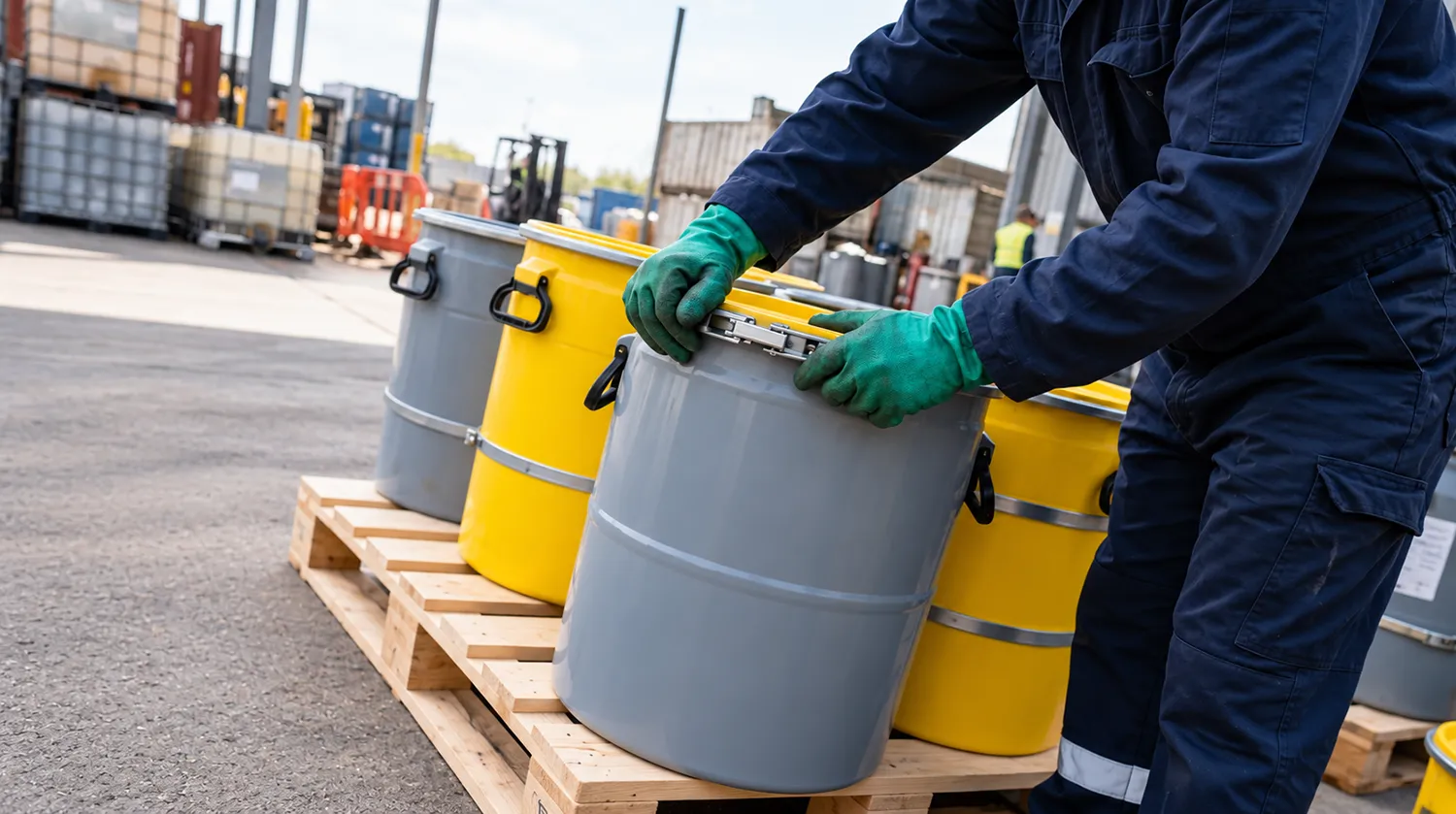
Consider, for example, a company that distributes plastic granules in industrial bags or a manufacturer that needs to transport drums containing chemicals.
In both cases, the pallet must provide a stable base, support the intended load and facilitate handling with forklifts or automated systems.
CP pallets meet these requirements through three key features:
- Standardised dimensions: These allow pallets to accommodate common industrial packaging formats.
- Specific structural configurations: Different models feature various base designs and board arrangements to meet different handling and storage requirements.
- Logistics compatibility: They facilitate transport planning and the operation of facilities designed to accommodate these pallet formats.
Their standardisation also encourages reuse and simplifies pallet management between manufacturers, distributors and industrial customers.
However, using a CP pallet does not automatically mean it is suitable for transporting any type of hazardous goods. Load capacity, load-securing methods and specific transport requirements must be checked for each operation.
 The 9 types of CP pallets: dimensions and applications
One of the main advantages of Chemical Pallets is that they are not limited to a single design. The CP pallet family consists of nine formats with different dimensions and structural characteristics.
Understanding these differences helps businesses choose the most suitable solution based on the product, its packaging and storage conditions.
| Type | Dimensions (mm) | Common applications |
|---|---|---|
| CP1 | 1,000 × 1,200 | Bags, boxes and industrial goods |
| CP2 | 800 × 1,200 | Loads compatible with European pallet dimensions |
| CP3 | 1,140 × 1,140 | Drums, big bags and industrial containers |
| CP4 | 1,100 × 1,300 | Bags and packaging requiring a larger surface area |
| CP5 | 760 × 1,140 | Loads requiring a smaller surface area |
| CP6 | 1,200 × 1,000 | Goods requiring a perimeter base |
| CP7 | 1,300 × 1,100 | Large-format industrial packaging |
| CP8 | 1,140 × 1,140 | Drums and industrial loads |
| CP9 | 1,140 × 1,140 | Drums, octabins and loads requiring a more reinforced base |
Reference dimensions published by EPAL. Applications are indicative and should be verified according to load weight, packaging and operating conditions.
CP1 and CP2 pallets: versatile formats
The CP1 pallet, measuring 1,000 × 1,200 mm, is one of the common formats used to transport goods packed in bags and boxes.
The CP2 pallet measures 800 × 1,200 mm, the same dimensions as a conventional Euro pallet. This similarity facilitates its integration into certain logistics facilities, although the two pallets differ in their construction and standardisation.
CP3, CP8 and CP9 pallets: square formats for industrial loads
These three models share dimensions of 1,140 × 1,140 mm, making them particularly suitable for certain industrial containers and maritime transport operations.
Their main difference lies in their base structure.
The CP3 has a simpler configuration, while the CP8 and CP9 incorporate different base structures designed to meet other support and handling requirements.
The CP9 stands out for its perimeter base, which can provide additional stability in certain applications.
CP4, CP5, CP6 and CP7 pallets: solutions for specific requirements
These models complete the CP pallet family with formats designed to accommodate goods of different sizes.
The CP4 and CP7 offer larger surface areas, while the CP5 has a narrower design. The CP6 shares the same footprint as the CP1 but features a different base structure.
For this reason, selecting a pallet model should not be based solely on its external dimensions: its construction is just as important as its size.
What are the differences between a CP pallet and a Euro pallet?
This is one of the most common questions among companies looking to purchase pallets for industrial use.
Although both are standardised wooden pallets, they are not designed to meet exactly the same requirements.
The conventional Euro pallet, known as EUR or EPAL 1, measures 1,200 × 800 mm and is widely used for distribution, storage and transport across numerous industries.
CP pallets, on the other hand, comprise a family of nine designs developed to meet the specific needs of the chemical and plastics industries.
The main differences are:
| Feature | EPAL 1 Euro pallet | CP pallet |
|---|---|---|
| Dimensions | 1,200 × 800 mm | Nine standardised models |
| Common use | General logistics and distribution | Chemical and plastics industries |
| Structure | Single standardised design | Different configurations depending on the model |
| Load types | General goods | Bags, drums, big bags and industrial packaging |
| Quality standards | EPAL specification | CP specifications and, where applicable, EPAL CP certification |
This does not mean that a Euro pallet cannot be used in the chemical industry or that a CP pallet is always stronger.
The choice depends on the type of load, its weight distribution, the handling equipment used and the customer’s requirements.
What does it mean for a CP pallet to be certified?
When a company requests certified CP pallets, it is important to distinguish between manufacturing a pallet in accordance with CP dimensional specifications and holding a recognised certification or licence.
CP formats originated as industry standards, but today the EPAL CP range is also available, subject to specific manufacturing, marking and quality control requirements.
Certification provides evidence that pallets are manufactured according to defined technical specifications.
It is also important not to confuse CP certification with ISPM 15 phytosanitary treatment: these are separate requirements, and both may be necessary.
When does your business need CP pallets?
Not every industrial company needs to use Chemical Pallets, but there are situations where their use is particularly recommended.
1. When transporting chemicals or raw materials
If your company manufactures or distributes chemicals, resins, polymers or industrial raw materials, CP pallets can make it easier to adapt packaging to the formats commonly used in the industry.
2. When handling bags, drums or big bags
The type of packaging directly influences pallet selection.
A stack of bags, several drums or a large flexible bulk container each have different support and weight-distribution requirements.
3. When your customer requires a specific CP model
In certain supply chains, manufacturers establish logistics specifications that their suppliers must follow.
These may include the use of CP1, CP3 or CP9 pallets, among other formats.
In such cases, using another pallet with similar dimensions does not guarantee acceptance.
4. When optimising automated processes
Facilities equipped with conveyors, automatic palletisers or specialised storage systems require pallets with consistent dimensions and characteristics.
Standardised CP models help reduce incompatibilities and facilitate logistics planning.
5. When exporting industrial goods
CP pallets can also be used for international shipments.
When the destination country requires compliance with ISPM 15 phytosanitary regulations, solid wood packaging must undergo the appropriate treatment and carry the corresponding marking, subject to any applicable exemptions.
Therefore, a CP pallet intended for export may need to meet both its specific model specifications and the relevant phytosanitary treatment requirements.
How to choose the right CP pallet
Before deciding which model your business needs, we recommend considering several factors.
The first is the type of goods being transported. A group of boxes does not require the same support base as a drum or a big bag.
It is also essential to know the total weight and how it is distributed across the pallet. A load concentrated at a few points may require a different configuration from one distributed evenly.
The storage system is another determining factor. Not all pallets perform in the same way when placed on the floor, stacked or stored on racking systems.
Finally, it is important to check the dimensions supported by handling equipment and the specifications required by the customer receiving the goods.
At Pallets Castillo, we recommend assessing all these factors together rather than choosing a pallet based solely on price or dimensions.
CP pallets and sustainability: reuse and the circular economy
The standardisation of CP pallets also offers environmental benefits.
By using recognised formats, companies can facilitate pallet recovery, sorting and reuse whenever their condition allows.
Wood is also a repairable and recyclable material, supporting management models based on the circular economy.
However, pallets that have been exposed to hazardous substances must be assessed before being reused or repaired. Potential contamination may affect how they need to be handled and treated.
Extending a pallet’s service life is not simply about using it more times, but about ensuring that the necessary safety conditions are maintained throughout its use.
Pallets Castillo: pallet solutions for the chemical and plastics industries
Every industrial activity has different logistics requirements. That is why choosing a pallet should involve more than simply comparing dimensions or prices.
At Pallets Castillo, we understand the importance of working with solutions tailored to the characteristics of each type of goods and the requirements of its supply chain.
Certified CP pallets are part of our range of solutions for companies requiring standardised formats for industrial applications.
Our goal is to help you identify the most suitable model, taking into account dimensions, load requirements, transport conditions and the technical specifications of your operations.
Because choosing the right pallet does more than facilitate the movement of goods: it also helps improve safety, optimise resources and prevent logistics problems.
Conclusion: choosing the right pallet makes a difference
CP pallets are much more than a variation of conventional wooden pallets. They provide a standardised solution designed to meet the specific requirements of the chemical and plastics industries.
Their nine formats accommodate different types of packaging, from bags and boxes to drums and large industrial containers.
Understanding the differences between CP1 and CP9, knowing what certification involves and selecting the right model can improve operational efficiency and reduce problems during storage and transport.
Does your business need CP pallets to transport chemicals, plastics or industrial raw materials? At Pallets Castillo, we can help you find the most suitable solution for your logistics needs.