The way companies manufacture, use and manage their packaging is changing. For decades, the priorities of the logistics sector have been to protect goods, optimise transport and reduce costs. However, another increasingly important objective is now being added to these goals: reducing waste and making better use of materials.
The European Union has taken a decisive step in this direction with the new Packaging and Packaging Waste Regulation (PPWR), legislation that introduces new sustainability, recyclability and reuse requirements over the coming years.
Although many companies associate this legislation with plastic packaging, bottles or consumer packaging, its scope is much broader. Industrial and transport packaging, including pallets, is also part of this transformation.
At Pallets Castillo, we know that the logistics of the future will require durable, efficient solutions capable of integrating into circular economy models. That is why we want to explain what the new European regulation entails, how it will affect the transport of goods and why reusable, repairable and recyclable wooden pallets can play an important role in this new landscape.
What is the European Packaging and Packaging Waste Regulation (PPWR)?
The PPWR, which stands for Packaging and Packaging Waste Regulation, is Regulation (EU) 2025/40 of the European Parliament and of the Council, adopted on 19 December 2024.
Its aim is to reduce the environmental impact of packaging throughout its entire life cycle, from design and manufacturing to reuse, recycling or waste management.
Unlike the previous Directive 94/62/EC, the new regulation establishes a common framework that is directly applicable across EU Member States, although some of its provisions require additional implementing measures.
The regulation pursues several key objectives:
- Reduce the generation of packaging waste.
- Encourage the design of recyclable packaging.
- Promote reuse wherever appropriate.
- Limit unnecessary packaging.
- Improve the collection, sorting and recovery of materials.
- Harmonise business obligations within the European market.
The regulation became generally applicable on 12 August 2026, although many of its obligations will be introduced progressively over the coming years.
This means that companies have a transition period to review their packaging systems and prepare their logistics operations.
How does the PPWR affect industrial and transport packaging?
One of the most significant aspects of this regulation is that it is not limited to packaging that reaches the end consumer. It also applies to packaging used to store, group, protect and transport goods between manufacturers, distributors and logistics operators.
This includes pallets, industrial boxes, containers, drums and certain components used to stabilise loads.
The change in approach is significant. Until now, many companies have chosen their packaging primarily based on price, strength or ease of handling.
Under the PPWR, it will become increasingly important to consider packaging lifespan, reuse potential and how materials are managed when they are no longer suitable for transport.
In other words, the value of packaging will no longer depend solely on how well it protects goods during shipment, but also on how many times it can be safely reused and what happens when it reaches the end of its useful life.
This approach creates new opportunities for recoverable pallet systems and materials that can be repaired.
Packaging reuse: European targets for 2030 and 2040
One of the most important developments introduced by the PPWR can be found in Article 29, which establishes specific reuse targets for certain types of transport packaging.
- From 2030: 40%. Minimum reuse target for transport packaging covered by Article 29(1).
- From 2040: 70%. Aspirational target aimed at increasing the proportion of reusable packaging.
These general targets are subject to the conditions and exemptions established in Regulation (EU) 2025/40.
In addition, the regulation includes specific requirements for certain operations within the same company, between affiliated companies or involving supplies between operators in the same Member State.
However, exemptions exist for certain types of packaging and operations, so each company will need to assess which obligations apply to its activities.
It is important to clarify that the PPWR does not require all existing pallets to be replaced, nor does it impose a general ban on single-use wooden pallets.
Instead, its aim is to increase the use of reusable packaging within organised reuse systems.
Therefore, companies that use large quantities of pallets will need to pay particular attention to how they manage, recover and reintroduce them into their operations.
Why are wooden pallets well positioned under the PPWR?
When discussing reuse and the circular economy, wood offers characteristics that deserve particular attention.
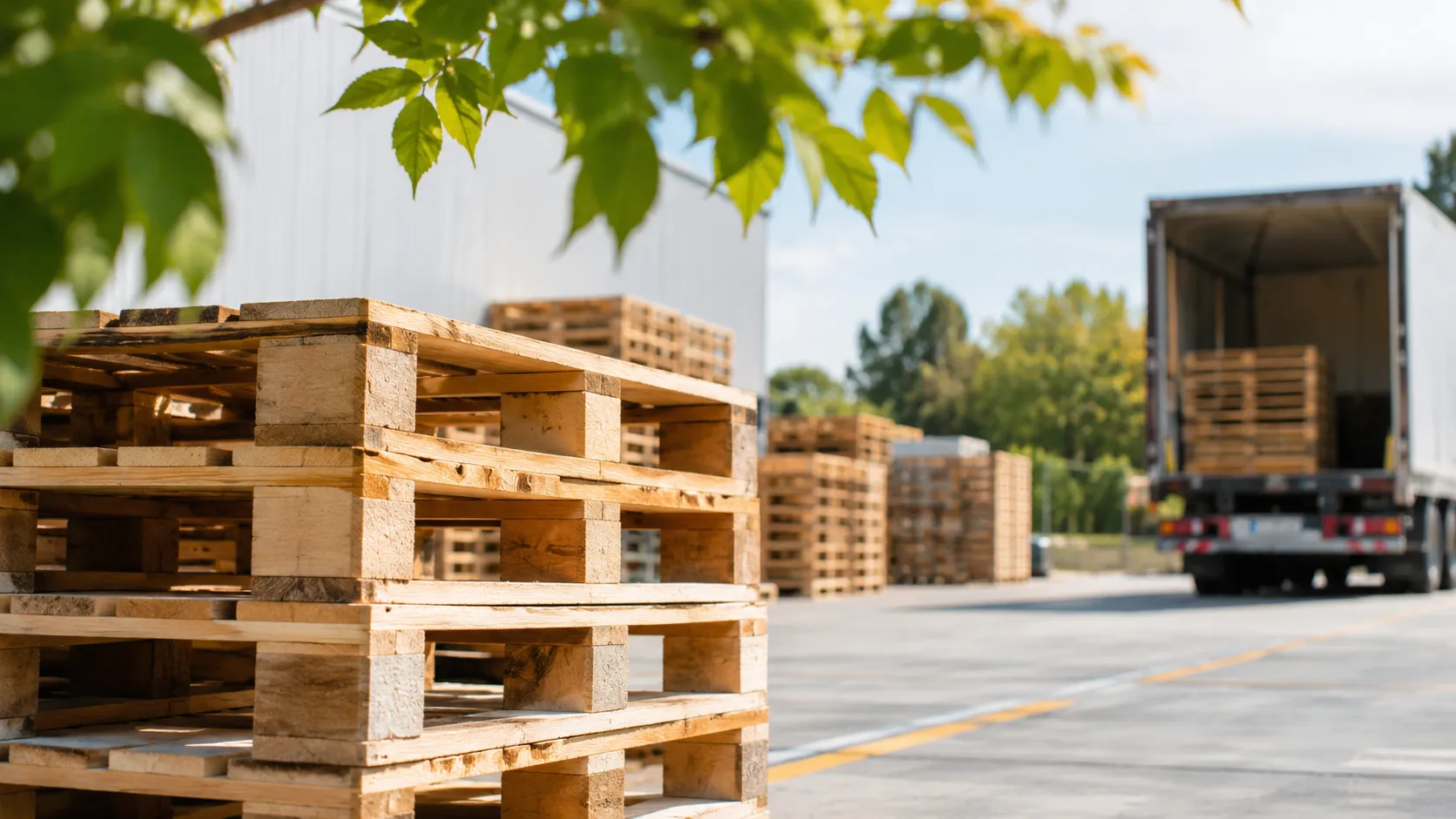
Wooden pallets have been used for decades in logistics systems where the same unit can complete numerous journeys before being taken out of service.
Their main advantage is that they combine strength, ease of handling and maintenance potential.
- They are reusable.
- They can be repaired.
- They are recyclable.
- They are made from a renewable resource.
Reuse is not the same as recycling: an important distinction
The PPWR places particular emphasis on reuse because it extends the useful life of packaging before it becomes waste.
This is why a repairable pallet offers a significant advantage: it can remain in circulation for longer without the need to manufacture an entirely new unit.
When carried out correctly, repair and reuse therefore become complementary tools for improving resource efficiency.
What will companies need to change in their pallet management?
Adapting to the new regulation will not depend solely on the type of pallet used. It will also require companies to review how packaging flows are organised within their operations.
Until now, some logistics operations have relied on systems in which pallets accompany the goods and do not always return to their point of origin.
Reuse models require a different approach to management, with mechanisms that enable packaging to be recovered, inspected and used again.
To prepare, companies can start by implementing five measures:
- Analyse pallet consumption. Determine how many units are used, which formats are most common and what percentage is recovered.
- Identify return logistics routes. Assess which routes allow pallets to be recovered without generating disproportionate logistics costs.
- Implement regular inspections. Separate units suitable for reuse from those requiring repair or removal from service.
- Use standardised formats. Facilitate pallet exchange and compatibility between different operators.
- Establish tracking systems. Record pallet movements, recoveries and repairs to maintain reliable information.
These measures can help reduce losses and improve inventory control, even before the main 2030 reuse targets take effect.
Furthermore, the regulation requires reusable packaging to be integrated into systems that meet specific operational, recovery and reconditioning requirements.
Does this mean single-use packaging will disappear?
Not necessarily.
The PPWR does not establish a general ban on all single-use transport packaging. Its requirements vary depending on the type of packaging, its application and the characteristics of the logistics operation.
There are situations in which reuse may present technical, health-related or economic challenges.
For example, certain international shipments, products with specific safety requirements or custom-made packaging may require tailored solutions.
The regulation provides for exemptions, including certain packaging used to transport dangerous goods and packaging specifically designed for large-scale machinery.
Therefore, the future of industrial packaging will not depend on using one type of pallet exclusively, but rather on selecting appropriate solutions for each operation and complying with the applicable requirements.
The future of wooden pallets in the circular economy
The new European regulatory landscape invites us to reconsider how we view transport packaging.
A pallet is no longer simply an auxiliary component that accompanies goods. Instead, it is increasingly regarded as a resource that must be managed throughout its useful life.
In this context, wood has characteristics that can facilitate the transition towards more circular models.
The ability to repair components, recover pallets and recycle materials at the end of their useful life makes it possible to develop resource efficiency strategies adapted to different sectors.
However, for these advantages to translate into tangible benefits, they must be supported by proper management.
A reusable pallet requires maintenance, safety checks and efficient return logistics. Otherwise, additional transport, losses or unnecessary repairs can reduce the economic and environmental benefits of the system.
That is why we believe the future will be shaped both by the quality of packaging and by how intelligently it is managed.
Pallets Castillo: ready for more sustainable logistics
At Pallets Castillo, we understand that our customers’ needs evolve alongside the industrial sector.
The new European requirements reinforce the importance of working with durable pallets that are suitable for each type of goods and designed to maximise their useful life.
Our experience in the wooden pallet industry gives us a thorough understanding of the needs of companies seeking efficient solutions for storing and transporting their products.
In response to the changes introduced by the PPWR, we believe it is essential to focus on material quality, structural strength, reuse potential and responsible packaging management.
Because sustainability is not just about choosing a material. It also means using it correctly, extending its useful life wherever possible and managing the resulting waste responsibly.