In a global context where international logistics depend on fast and safe movements, wooden packaging —especially pallets— represents a critical checkpoint for customs. Untreated wood can carry insects, fungi, and harmful organisms, posing a phytosanitary risk capable of blocking entire shipments at the border.
To prevent this, international regulations require strict heat treatment (HT) measures under the ISPM 15 standard. The HT certificate has therefore become an essential document for exporters and logistics managers, ensuring compliance, biosafety, and operational fluidity.
 In this guide you will learn:
- Why pallets can be vectors for pests.
- What the ISPM 15 standard requires and how HT heat treatment works.
- How to interpret the IPPC marking and the certificate.
- Quality best practices, common mistakes, and an actionable checklist.
- Frequently asked questions and a final CTA to request your quote.
Why can pallets be a vector for pests?
Wooden pallets are a natural medium where insects and fungi can develop if not properly eliminated. The most common risks include:
- Wood-boring insects (beetles, borers).
- Internal larvae that are difficult to detect at sight.
- Fungal spores that can proliferate with moisture.
- Quarantine pathogens, whose presence may require retention or even destruction of the cargo.
Impact on customs and borders
Phytosanitary authorities in importing countries may:
- Hold goods for several days.
- Request additional fumigation at a high cost.
- Reject the entire shipment.
- Issue sanctions or suspend permits.
HT treatment and its certificate act as a preventive barrier, demonstrating that the wood has undergone a safe and validated process.
ISPM 15 and the HT Certificate: what they are and why they matter
What is ISPM 15?
ISPM 15 (International Standards for Phytosanitary Measures No. 15) is the global standard regulating wooden packaging in international trade. It establishes mandatory treatments to prevent the spread of pests between countries.
It applies to:
- Pallets
- Crates
- Cages
- Dunnage and other wooden packaging thicker than 6 mm
What is HT heat treatment?
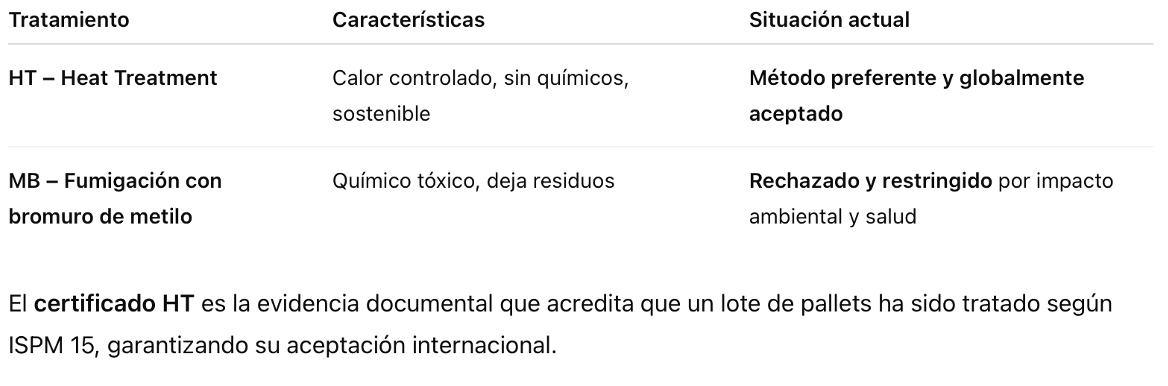
HT (Heat Treatment) consists of raising the core temperature of the wood to ≥56°C for at least 30 minutes. It is important to note that:
- This is not the ambient temperature of the kiln.
- The temperature must be reached at the core of the wood, where larvae or pathogens may remain.
HT vs. MB (Methyl Bromide)
How heat treatment (HT) is carried out: step-by-step process
The heat treatment process is highly technical and based on precise controls that ensure its effectiveness.
1. Pallet preparation
- Classification by type and dimensions.
- Verification of integrity and appropriate initial moisture level.
- Batch identification to ensure traceability.
2. Loading the kiln
- Pallets are placed into specialized thermal chambers.
- Enough space is left to ensure proper heat circulation.
3. Installation of sensors
- Sensors are inserted into selected boards.
- The sensors monitor core temperature, not ambient temperature.
4. Heating curve and temperature rise
- The controlled heating cycle begins.
- The system raises the temperature until the core reaches ≥56°C for ≥30 minutes.
5. Real-time data recording
- The kiln records temperature graphs, times, and values.
- These records are archived for audits and certificate issuance.
6. Compliance verification
- The technical supervisor validates that all points comply with ISPM 15.
- If any sensor does not reach the required temperature, the cycle is extended.
7. Cooling and unloading
- Pallets are allowed to cool to avoid condensation and fungal growth.
8. Segregated storage
- Pallets are physically separated from untreated wood.
- Cross-contamination is prevented.
9. Marking and issuance of the HT certificate
- The IPPC/ISPM 15 stamp is applied and the corresponding document is issued.
The IPPC marking: what it must include and how to interpret it
Every heat-treated pallet must carry a permanent, visible, and indelible marking:

For example:
- ES-12345-HT → Spain, producer 12345, heat treatment.
Key marking requirements
- It must be legible and not fade during transport.
- It must appear on two opposite sides of the pallet.
- It must include the wheat/IPPC symbol.
- No specific date or color is required.
The HT certificate complements this marking with:
- Batch number
- Treatment date
- Authorized producer information
- Associated thermal records
Requirements by destination markets (overview)
Although ISPM 15 is a global standard, each region may apply nuances:
- European Union: Full acceptance of the ISPM 15 stamp; random checks.
- United States / Canada / Mexico: Joint NIMF 15 system; inspections by APHIS and CBSA.
- Latin America: Widespread adoption; some countries require the stamp to be especially visible.
- Asia (China, Korea, Japan): Strict phytosanitary controls, especially in food and chemical sectors.
Recommendation: Always verify the specific requirements of the importing country, especially in regulated sectors such as food, pharma, and chemicals.
Quality, inspections, and post-treatment moisture control
To ensure that pallets remain compliant:
- Check that the wood does not exceed high moisture levels (fungus risk).
- Maintain periodic calibration of probes and equipment.
- Avoid contact between treated pallets and untreated wood.
- Record and archive certificates and heating curves.
- Conduct regular internal and external audits.
Logistical and cost benefits for the exporter
Using pallets with an HT certificate provides clear advantages:
- Reduced border rejections and costs from additional fumigation.
- Fewer interruptions in the supply chain.
- Compliance with safety programs (food, pharma, chemical).
- Improved exporter reputation with global clients.
- Longer pallet lifespan and higher quality, reducing infestation risks.
The HT certificate is an essential tool to ensure phytosanitary safety, avoid unexpected customs costs, and guarantee smooth international logistics. Exporting with pallets treated under ISPM 15 protects your cargo, your reputation, and the entire supply chain.